We Buy Used and Surplus Static Transfer Switches
Data Center Buyers buys used and surplus static transfer switches from data centers and other critical facilities throughout the US and Canada. We consider rack-mounted units and floor-standing STS cabinets, including identifiable 208 V and 480 V equipment. Send an asset list and photos through our online quote form or call 951-403-5738. We provide a written offer within 24 hours after receiving those materials, typically one business day.
Selling Static Transfer Switches: What to Know
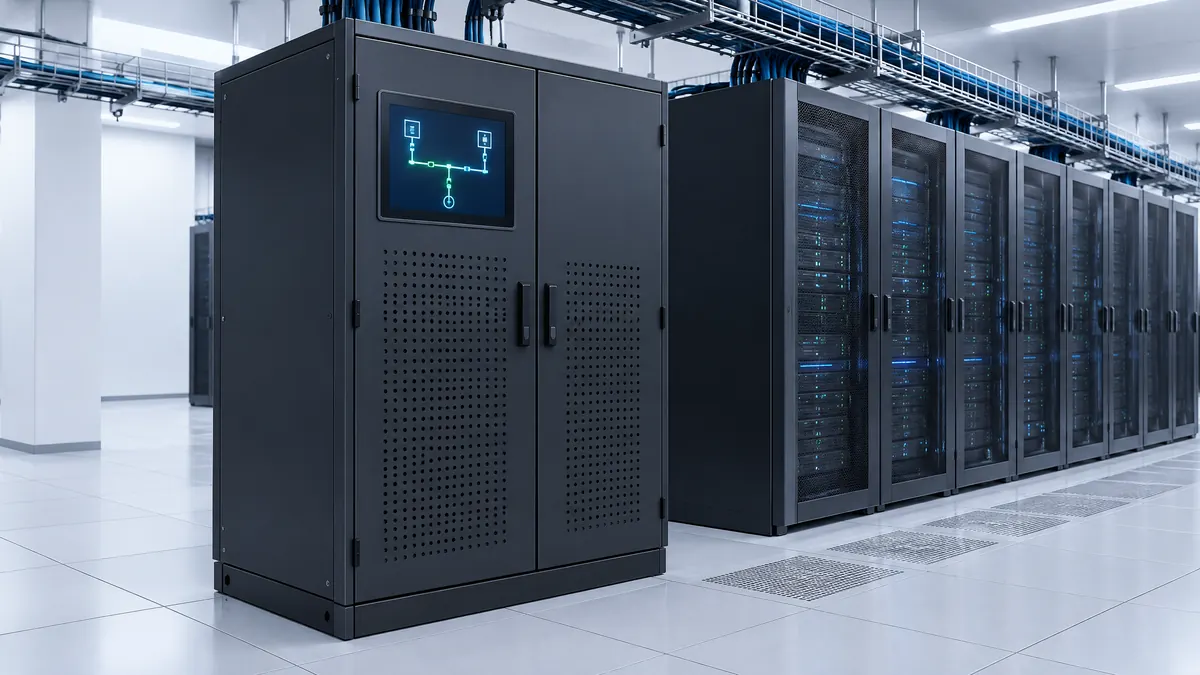
A static transfer switch selects between two AC sources to serve a critical load. Solid-state designs use semiconductor switching elements rather than relying on mechanical contacts for the source transfer. In a data center, an STS can connect a single-input load to alternate UPS-backed power paths. That application makes source configuration and maintenance history important when selling removed equipment. A cabinet from a dual-bus installation is not described adequately by its enclosure size or the phrase 'transfer switch.' Preserve its model designation, voltage, continuous-current rating, pole configuration, and drawings so the equipment can be evaluated as a specific assembly.
Our buying scope includes floor-standing STS equipment around 100–1200 A, as well as rack-mounted static transfer equipment whose ratings must be listed separately. Vertiv Liebert STS2, ABB Cyberex SuperSwitch 4, and Eaton PDI WaveStar TFA are identifiable families; their available configurations differ. Do not assume every current rating is offered at both 208 V and 480 V. Three-pole and four-pole assemblies also need separate inventory entries because neutral switching changes the configuration. Whether the unit was removed during a power-path redesign or remains installed pending shutdown, send its records before separating integral bypass hardware or removing identification labels.
Static Transfer Switches We Buy
Floor-standing three-phase STS cabinets
- 208 V static transfer cabinets with readable nameplates and the original source and load configuration identified.
- 480 V static transfer cabinets removed from dual-source critical-load power paths, with their actual current ratings recorded.
- Assemblies around 100–1200 A, including three-pole and four-pole variants identified separately rather than grouped by cabinet appearance.
Identifiable static transfer switch families
- Vertiv Liebert STS2 assemblies, with the exact model, voltage variant, amperage, and installed options listed.
- ABB Cyberex SuperSwitch 4 cabinets, including available display, event records, and integral bypass components.
- Eaton PDI WaveStar TFA static transfer switches, with the pole count and matching interlock keys kept with each unit.
Rack-mounted and integrated static switches
- Rack-mounted solid-state transfer units with mounting hardware and both source connection arrangements documented.
- Identical rack STS lots grouped by model and rating, with input connections and output arrangements photographed.
- STS assemblies integrated into distribution cabinets, offered with drawings showing which hardware belongs to the static switch.
Surplus and retired STS packages
- Never-installed static transfer switches from cancelled data hall projects, with packing lists and available factory documents.
- Operating STS cabinets released after a UPS-path upgrade, supported by maintenance history and the last operating date.
- Older, incomplete, or non-working STS equipment with known faults and missing components disclosed for resale or parts evaluation.
What Affects Your Offer for static transfer switches
Voltage, current, and source configuration
Record the actual nameplate voltage and current rating, not the capacity of the upstream UPS. Include frequency and the source/load one-line. Equipment suitable for a particular power path depends on these details; a larger cabinet alone does not establish broader reuse potential.
Pole count and neutral arrangement
In a three-phase STS, a three-pole version switches the phases without switching the neutral; a four-pole version also switches the neutral. Supply the exact designation and drawing. Similar-looking cabinets with different neutral arrangements should not be presented as interchangeable units.
Switching electronics and service history
Available records for semiconductor modules, control boards, fans, and power supplies help explain condition. Disclose unresolved source alarms, transfer faults, or operation limited to bypass. A powered display is useful information, but does not establish that the complete transfer system is functioning.
Integral bypass and cabinet completeness
Keep bypass switches, isolation hardware, interlock keys, displays, covers, and fitted monitoring components associated with the correct cabinet. Missing parts can narrow reuse options. Photograph installed components safely or supply drawings rather than stripping the enclosure to create an inventory.
Identification and configuration records
Readable serial labels, model codes, option lists, and manufacturer submittals make an STS easier to identify. Include any marked short-circuit rating and standards information exactly as shown. Do not infer ratings from a similar unit or assign current product specifications to older equipment.
For broader pricing context, read our guide: Used switchgear value on the secondary market.
What to Send for an Accurate Quote
- Asset list showing STS manufacturer, exact model, serial number, quantity, voltage, frequency, current rating, and pole count for each configuration.
- Clear nameplate and exterior photos, including rack mounting, cabinet labels, and any visible short-circuit or standards markings without opening energized equipment.
- Available one-line and manufacturer drawings showing both sources, the load connection, neutral arrangement, and integral bypass equipment.
- Existing display photos, alarm or event exports, service reports, last operating date, and a plain description of known faults or bypass-only operation.
- Inventory of interlock keys, mounting brackets, monitoring cards, loose accessories, and missing items, identified to the corresponding static transfer switch.
- Site city in the US or Canada, ownership confirmation, shutdown window, removal deadline, cabinet dimensions, available weight documentation, and loading-route restrictions.
When Companies Sell static transfer switches
- A data hall power redesign retires 208 V STS cabinets after loads move to the replacement power paths, leaving documented units available for a coordinated sale.
- A colocation shutdown releases floor-standing 480 V static switches once the facility team confirms downstream loads no longer depend on those cabinets.
- A rack refresh removes identifiable rack-mounted solid-state transfer units, which can be listed in matched lots with brackets and connection details preserved.
- A cancelled expansion leaves unused STS cabinets or a critical-process upgrade releases older units; both can be submitted with their configuration and condition clearly described.
Removal, Safety, and Logistics
An STS has two source connections, and bypass paths must be included in the removal plan. Qualified electricians must de-energize and lock out the equipment before disconnection; do not open energized cabinets for quote photos. Removal is coordinated with your electrician or facility team around adjacent operating loads. When we purchase, de-installation, rigging, and insured freight nationwide are included, with no removal or recycling fees deducted from the offer. Pickup is typically scheduled within a few business days after acceptance, around access, security, and uptime needs. Payment is by company check or wire transfer, on pickup or per agreed terms for larger projects.
Power Equipment Removal Is Planned Before Pickup
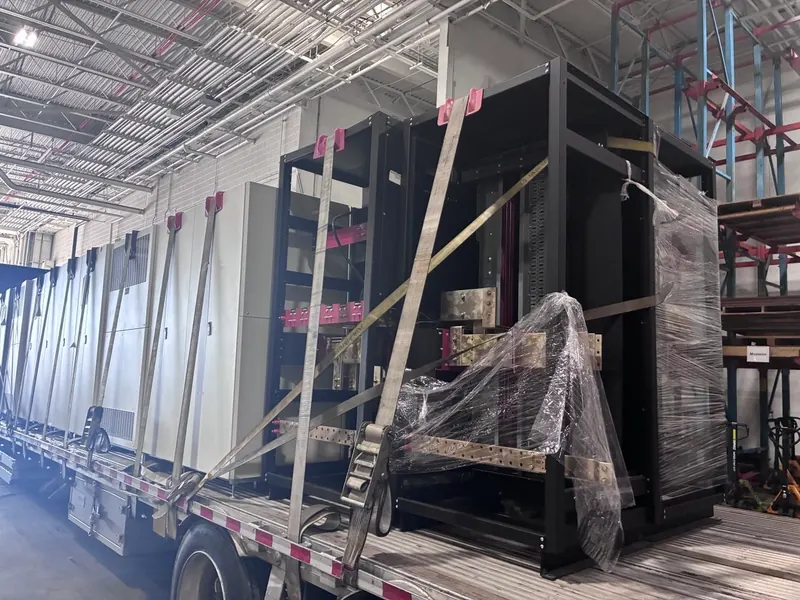
This owner-provided project photo shows data center power equipment secured on a flatbed during a removal. Switchgear sections, breakers, and transfer equipment are heavy, so dimensions, weights, access routes, and rigging needs are confirmed with your team before the truck arrives.
Get a Written Offer for Your Static Transfer Switches
Send nameplate photos, quantities, and your removal timeline. We reply with a written offer within 24 hours of receiving the list and photos.
Static Transfer Switches: Seller Questions
Can I identify a four-pole STS just by counting its connected wires?
No. A three-pole static switch can have a neutral connection without switching that neutral. Four-pole construction switches the three phases and the neutral. Use the model designation and manufacturer drawing to establish the configuration. Send existing records if the label is unclear; do not open energized equipment or disturb wiring to count connections for a quote.
Should I list 208 V and 480 V STS cabinets as separate assets?
Yes. Group units by their actual voltage, current rating, and model configuration, even when they share a family name. The two sources normally need matching nominal voltage, frequency, and phase rotation. An STS is not itself a voltage-conversion device. Where a switch is integrated with distribution equipment, include drawings so its own rating is not confused with a downstream transformer's output voltage.
Are all rack transfer units carrying an STS name solid-state switches?
No. Product naming alone does not establish the switching technology; some compact rack products use relays despite carrying STS naming. Send the exact manufacturer and model, available datasheet, input connection photos, and mounting details. Identify semiconductor-based units separately from relay-based rack transfer equipment. This prevents a mixed rack lot from being described as one uniform static-switch configuration.
What records help sell a static switch that has been running only in bypass?
State that it was operating in bypass and describe the reason, if known. Include existing alarm logs, service reports, the last normal operating date, and details of removed electronics or missing keys. Do not perform a live transfer demonstration for a quote. Older or non-working STS equipment can still have resale or parts value; what cannot be resold is recycled responsibly.
Which standards information should I send from an older STS cabinet?
Photograph the equipment's actual standards and rating labels and include available manufacturer submittals. UL 1008S addresses solid-state transfer switches, but that does not mean every older STS carries that marking. Keep any short-circuit rating and its stated conditions with the asset record. We evaluate the identified equipment rather than assuming a current family datasheet describes your retired cabinet.
Related Switchgear We Buy
- Automatic Transfer Switches
- UPS Switchboards & Bypass Cabinets
- New Surplus Switchgear
- Damaged or Non-Working Switchgear
- All Electrical Switchgear
Static Transfer Switches Brands We Buy
Get a written offer within 24 hours
Send your asset list and we respond with a firm written offer, typically within one business day. We pay top dollar, handle rigging and freight, and provide secure data wiping with a certificate on request.
Call 951-403-5738 or request a quote online.